Detective Morris and the Case of the Stolen Dog and the Capture of Secret Sloth
By Carly Pierson and Leah Starr
During the making of our video, we had a ton of fun being Detective Morris and Secret Sloth! But more than that, we learned about transformations, which include dilations, rotations, and reflections. We had covered these topics earlier in the year, but when we went over them again with our video project, we delved much deeper into the concepts. We both agree that we re-learned a lot about transformations, dilations, rotations, and reflections.
To see the extent of our knowledge on these topics, watch our video! But for now, here’s a brief description of each of them.
Dilations are when you make a shape bigger or smaller by a specific amount, such as 3x smaller or 2x bigger.
Rotations are when you rotate an image around the four sections of the graph, using clockwise or counter-clockwise rotations. A rotation is usually 90 °, 180°, 270°, or 360°.
Reflections are based on the reflection lines and line bisectors. A point or image is reflected across the reflection line and the line bisectors connect the two reflections by going across the reflection lines at a 90° angle.
. . . . . . .
The Sliceform Cross
and the
Geometry Behind It
By Carly Pierson
The amazing thing about sliceforms is that it is all about taking two-dimensional things such as rectangles or circles, and transforming them into three-dimensional objects, such as a kiwi bird, or a light bulb, or even, yes, a cross.
You might ask, “Why a cross?” My reasoning is that a) I am a Christian, so that’s the basis, b) I couldn’t think of anything else I would want to make, c) I decided I wanted to give my sliceform to my Grandma. I decided that Grandma wouldn’t have much use for a lightbulb, so I decided a cross would be the best way to go for her.
Originally, I thought it would be fairly easy to make a sliceform cross. I had the exact picture of what it would look like in my mind. I didn’t take into account the many measurements I would have to make, or how I would have to rethink the base because it kept toppling over, or how precise everything had to be. In the end, I realized that I really needed geometry to figure out how to make this sliceform cross. Okay, measuring the sides to determine make a rectangle doesn’t sound too difficult, but when you have to keep track of the dimensions of every single “slice” you have to make your object, it gets a bit more tricky. For example, I found out that I couldn’t skip from having a width of 4 cm to having a width of 5 cm—it would fall right over. Instead I had to go the gentler way, increasing the diameter more slowly.
I am very proud of my sliceform cross, even though I have no idea why it has such terrible posture. But I was able to use many skills, such as the formulas for rectangles, and a ton of patience. But in the end it was worth it!
This class is taught by Kristi Good.
Math Update for 2011
So far this year, we have been studiously studying the following concepts within the sect of geometry:*Knowledge and vocabulary such as circumscribe, inscribe, parallel, congruent, perpendicular lines, point of concurrency, angle bisectors, median, midsegment, perpendicular bisectors, altitude, orthocenter, centroid
Trapezoids Polygons, right triangles
Squares--------------all sides and --------isoceles triangles
Rectangles angles are obtuse triangles
Rhombus congruent acute triangles
* A conjuncture is a statement that is likely to be true, but has not been proved
*Recognizing patterns and modeling them with equations (Finding formulas for tables)
ex: sides/ 3 / 4 / 5 / 6/ 7 /
triangles/ 1 / 2 / 3 / 4 / 5 / f(n)= n+2
A polygon with 35 sides would have 37 triangles in it
Inductive reasoning is a logical argument that makes generalizations. You're looking for clues to solve a mystery. You're looking for a pattern, and you don't already know what it is. Inductive reasoning is the process of observing data, recognizing patterns, and making generalizations about those patterns.
That's the main difference between inductive reasoning and deductive reasoning: With inductive, you don't have the information you're looking for, such as a formula for a pattern; with deductive, you have the formula, or whatever you're looking for, and now you're trying to solve the problem.
Deductive reasoning is the process of showing that certain statements follow logically from agreed-upon assumptins and proven facts. It is based upon the generalizations. It has to do with, 'if this is correct, then this is also correct.' You know if it's deductive reasoning if you use words such as then, but, so, if, therefore. It's reasoning for something. When we do 2-column proofs, we use deductive reasoning. We take the information, and say, 'if this is the definition of a right angle, then 'angle a' must be congruent.' We also use deductive reasoning when we're trying to find the interior angles of a triangle. We know that the angles must all equal up to 180 degrees, so how can that help us get the answer?
* Special angle relationships include vertical angles, complementary angles, and supplementary angles. Vertical angles are angles that are opposite eachother, non-adjacent angles formed by two intersecting lines.
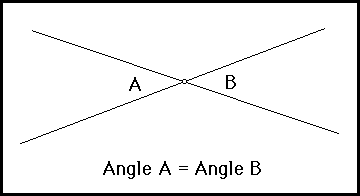
Supplementary angles are angles that add up to 180 degrees.

en.wikipedia.org/wiki/Supplementary_angles
Complementary angles add up to 90 degrees.

en.wikipedia.org/wiki/Complementary_angles
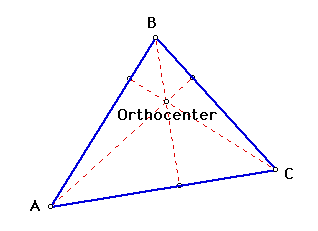 *Points of Concurrency of Triangles
Orthocenter: The orthocenter is the point that the 3 altitudes of a triangle meet and intersect.
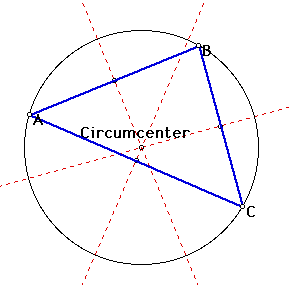
Circumcenter: The circumcenter is the point that the 3 perpedicular bisectors of the sides of a triangle intersect, and is the center of the circle that is cirumscribed around the triangle, touching all 3 points of the triangle.
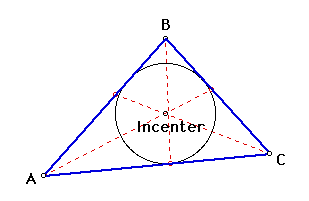 Incenter: The incenter is the point that all the angle bisectors (3 lines that go from an angle to the center of a side,) meet and intersect. It is also the point that is the center of a circle that is inscribed in the middle of a triangle.
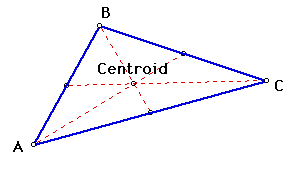
Centroid: The centroid is the point that is where the 3 medians of a triangle intersect. In addition, it is the center of gravity for the triangle.
All points of concurrency pictures: Thanks to geom.uiuc.edu/~ demo5337/Group2/ concurdefts.html
* How to find the sum of all exterior and interior angles of a polygon. (Hint: All exterior angles= 360 degrees, and the formula for finding the sum of the interior angles is...
180 (number of angles) - 360= sum of interior angles
Then, take the sum of the interior angles and divide it by the number of angles, and you will have the degree of each interior angle--that is, if the polygon is regular.
Thanks for stopping by!
~Mizz Blogsta
~ ~ ~ ~ ~ ~ ~ ~ ~ ~ ~ ~ ~ ~
Fall 2011 Update Part II
1. Here's an explanation for discovering and proving triangle properties:
Triangle properties include all of the following: vertex, base, altitude, median, area, perimeter, interior angles, and exterior angles.
*The vertexes of a triangle are the three points, where two sides meet.
*The base of a triangle can be any of the three sides, but the one that is drawn flat at the bottom is usually looked at as the base. In an isoceles triangle, it is usually the side that is not the same length as the other two sides.
*The altitude is a line that makes a 90 degree angle with the base.
*The median is a line from the vertex to the midpoint of the opposite side. When three medians intersect, it's called the centroid of the triangle.
*The area is the space inside the triangle.
*The perimeter is the lengths of all three sides of the triangle put together.
*The interior angles are the angles inside the triangle, and, together, must add up to 180 degrees.
*The exterior angles are the angles outside the triangle, and together add up to 360 degrees. If you add corresponding interior and exterior angles together, they will add up to 180 degrees.
*It's also important to note the three different kinds of triangles: A right triangle has a right angle; an isosceles triangle has two sides that are the same length; an equilateral triangle triangle has all sides the same length and all interior angles are equal; a scalene has no sides the same length; an obtuse has one angle that is greater than 90 degrees; an acute has all angles less than 90 degrees.
2. Polygon properties:
Polygon properties include all of the following:
Side, vertex, diagonal, interior angles, and exterior angles.
*The side of a polygon is any line segment that makes up a polygon.
*The vertex is the point at which two line segments meet.
*The diagonal is a line between two vertices that isn't a side.
*An interior angle is an angle that is inside the polygon that is formed by two adjacent sides inside the polygon.
*An exterior angle is an angle that is outside the polygon and that is formed by two adjacent sides outside the polygon.
*It is also important to note that the types of polygons are convex and concave. In a convex polygon, you would be able to draw a line through it, anywhere, and it would only cut across two sides. Also, every exterior angles is less than 180 degrees. A concave polygon is abnormally shaped and you would be able to draw a line through it that might hit three or more sides, and at least one exterior angle is more than 180 degrees.
*I would also like to note that there are special polygons, and within that category are special polygons-- square, parallelogram, rhombus, rectangle, and trapezoid-- as well as special triangles-- right, equilateral, scalene, isoceles, obtuse, and acute.
*To figure out the interior angles, take the number of sides, multiply it by 180, and then minus 360. This will give you the total sum. If the polygon is equilateral, you can then divide that number by the number of sides to get each interior angle.
*All exterior angles add up to 360 together.
3.Out of everything this year in geometry, finding and proving the properties of polygons has been my favorite thing. I view it as mostly problem-solving, because you have to find the degree of the angle, the length of the side, etc. It's like a mystery to solve.
I. Give an explanation, example problem and/or visual of the Geometry topics we have covered this semester:
1. Inductive and Deductive Reasoning in geometry *2. Recognizing patterns and modeling them with equations *
3. Special angle relationships *
4. Points of concurrency of triangles*
5. Constructions w/compass and straight edge: (points of concurrency, congruent segments, angles, bisectors, and perpendiculars)
6. Discovering and proving triangle properties*
7. Discovering and proving polygon properties
II. From the list above, choose one geometry topic that you enjoyed learning about and give a brief explanation of why you enjoyed it and some evidence (explanation or work) of your understanding of the concept.
IV. From your own comp. book, scan in at least one of your best/favorite comp. book inserts or chapter reviews to show off on your DP.(Optional alternative to step III-Using geometry software (such as Geogebra) thoroughly recreate the Circles and Tangents POW that we did at the beginning of the semester.
