Rhetoric of Food Project Reflection
For the second half of this semester, we learned all about food. We read the book An Omnivore's Dilemma, by Michael Pollan and consumed other forms of rhetoric along with it, such as watching the movie Supersize Me, parts of The Botany of Desire, and various other articles and video clips of about CAFO (Contained Animal Feeding Operation) conditions, slaughterhouses, industrial farms, small family farms, packaging operations, and food in general.
During this unit, we learned several big truths: 1) Almost all processed food we eat, from cereals, to dried fruit, to bread, to chicken nuggets, to... well, just about anything you can think of that isn't absolutely raw, contains corn and/or soybeans. It comes in forms that make it difficult to recognize it as what it started out as, corn and soybeans. Some examples are high fructose corn syrup, citric acid, soybean oil, and a ton of those ingredients with names so long you can't pronounce them.
2) Even if you buy organic food, it doesn't necessarily mean the conditions of the cows who produce the organic milk are going to be much better than the conditions of the cows who live in regular industrial feedlots. And if you buy organic spinach, don't assume that what you are eating was grown by a nice little farm. Unless you buy your products at the farmer's market, you can assume that all your organic food comes from industrial organic farms. The same goes for all organic eggs, meat, fruits, and vegetables. Many times, the only difference between organic industrial food and industrial food is the word organic. Yes, it means that you aren't consuming harmful pesticides and herbicides, which helps the earth and you, but don't assume that the animals you are eating are getting a better deal. And DON'T buy the wonderful stories and pictures about cows grazing in open fields or happy chickens wandering around in their roomy yards. Don't buy the rhetoric of the grocery store poets.
3) Animal conditions in CAFOs are horrible. Animals are not treated well. They are so sick. Cow are fed corn and molasses and antibiotics. They weren't meant to eat corn and so they get very, very sick. The only way they are kept alive is by the antibiotics. There is a high mortality rate for chicks and chickens because they are so packed together. Chicks' beaks are burned or cut off so they won't peck at each other because they are so close together. Pigs bite each other on the tails, so the tails are chopped off. Workers are cruel to the animals. I couldn't stand knowing this and still eat the meat from these places. So now, I eat meat very minimally. I don't understand how you can know this and still be a carnivore. Maybe it's too engrained into their lives to change.
I have already read The Omnivore's Dilemma, as well as various other books about feeding operations, animal rights, slaughterhouses, vegetarianism, and food in general. (I particularly enjoyed Skinny Bitch and In Defense of Food, the latter by Michael Pollan.) Don't forget various cookbooks! Health and food in general are very interesting to me. Pouring over cookbooks and dreaming up meals is something I like to do if I have the time. Learning how to make food, too. (I am accomplished in the art of making minestrone, lemon bars, and various other yummies.)
. . . . . . . . .
Compassion isn’t Just for People
Carly Pierson
Take a glance at my poster, what will first catch your eye? There is a cow and a girl who are looking at each other with a sort of tenderness in their eyes. They know each other. This is to signify the relationship people can have with animals, even animals we eat, and that these animals have emotions and attachments, just like people do. It creates an emotion of tenderness and compassion. In the background, there are sections of writing on both sides and a poem going down the middle. One story on the poster is from the perspective of a cow who loves her life in the green fields. It may remind you of the cow in the main picture who is looking at the girl, and it is meant to be a comparison to the other story and poem. The poem is about the conditions of the animals in CAFOs, or Confined Animal Feeding Operations, and the second story is from the point of view of a different cow who lives in a CAFO. The idea behind the last two are to give details about the conditions of the animals’ lives in CAFOs and to help the reader be empathetic toward the animals from whose perspective you are reading from. The overall idea behind this piece is to stir up emotions about treating animals, even if they are to be our food, humanely and with compassion.
In a study conducted by the Harvard School of Public Health, results say that about 34% of people eat red meat 2-3 times a week, and about 16% eat red meat almost daily. That is a lot of meat, therefore a lot of animals that are raised to be our food. According to Farm Animal Rights Movement, more than 25 billion animals are killed by the meat industry each year, and that the “average American meat-eater is responsible for the abuse and death of about 90 animals per year.” On the other hand, Vegetarian Times has reported that about 3.2% of people in America are vegetarians and 0.5% are vegans. The fact that these statistics have been growing proves that more and more people are becoming conscious about what they are eating and about where there food comes from. It’s time people start realizing that there is a cost to what they are eating. The cost is 55 square feet of rainforest, 4 pounds of grain, 600 gallons of water, some paper and plastic, 640 quarts of methane a day the cow is alive, and the cost and fuel to get the burger where it is and to get you to where the burger is… all that for one hamburger. It is obvious to me that it is not worth it for the animal or the planet. Now it’s up to you to make the decision to get your meat from a local, humane farm, or to stop eating meat, or even to stop consuming animal products, period.
Both people and animals are beings. We are living, breathing, feeling beings. When you put animals into feedlots, you are not allowing them to just be animals. They are going from the beautiful beings they were meant to be into a machine. The machine works and thumps and gags and billows smoke and waste. It pumps in cows, fattens and sickens and slaughters them in the smallest amount of time possible. This inhumane of treating animals is not just. It is not right. Gandhi said, “The greatness of a nation and its moral progress can be judged by the way its animals are treated.” Yet we live with the knowledge that it is being done by the hour. We ignore it so we don’t have to deal with it. Enough is enough. The brutality against animals needs to stop now.
Sources:
sodahead.com/living/public-opinion-most-people-eat-red-meat-two-to-three-times-a-week/question-2516873/
happycow.net/why_vegetarian.html
vegetariantimes.com/article/vegetarianism-in-america/
epa.gov/oecaagct/ag101/demographics.html
smallfamilycsa.com/about
cfra.org/ruralmonitor/2010/04/29/growing-number-small-farms-living-land
newcommunityproject.org/fastfood.shtml
. . . . . . . . . .April 20th, 2012
Reflection of Cat's Cradel by Kurt Vonnegut
We Think We’re Smart, But We’re Not
As humans, we think we know everything about anything. We often think we’ve got it all figured out. But after reading Cat’s Cradle, I have found many underlying themes, but the one that stood out the most for me was that people aren’t as smart as we think we are. We are oftentimes forgetful, arrogant, and self-righteous, though possibly meaning well. And possibly not thinking whatsoever about the effects of our actions. For example, humans have created the atom bomb. I ask, who are we to make a bomb that can destroy the world? We think we are so smart to make something like that, yet how can we hold the responsibility for it? We think we are doing a smart thing when we drop the atomic bomb on two cities, but what on earth were we thinking? Do we have the right?
In the book, a scientist discovered and created ice-nine. This in itself was not a good decision, but when his children got a hold of it and used it as a means to get things they wanted, such as a husband or lover, it became clear that it was a huge mistake. Felix thought he would be advancing technology, or just creating something for the sake of creating it. But he did not pause and think about the ‘what if.’ He did not reflect on what he was about to do and say to himself, ‘Gee, what if the ice-nine spilled into a vast body of water that froze all of the earth’s water supply?’ No. In creating the ice-nine, he declared himself righteous. He declared mankind righteous, for who could not be righteous who had created such a thing as ice-nine?
The book itself was the final project in college for Kurt Vonnegut, for it was so much a study of people. We think we’re smart, but we’re not. Or at least not as smart as we deem ourselves. We all have something to learn from ourselves and to learn from others. Or, we can just look at others as they fumble over their mistakes and humanness and we smirk and snicker and then are caught off guard as we do the same thing. And we thought we were so much better, so much smarter, than them. We are ever learning and ever forgetting. So it goes with people.
. . . . . . . . . .
April 17th, 2012
Hatchet Reflection
Brian goes through a very natural process as he blindly pulls his way through surviving. He begins with finding the berries, which are the easiest and closest and quickest way to eat. From there he moves on to fish, which are the next hardest to catch, because he has to make a spear and bow and arrow. Lastly, he moves on to rabbits and foolbirds, which require even more skill and knowledge. Actually, he has much of the needed knowledge already, from learning how to catch fish, but it is his new self, his new way of looking at things, that helps him catch the foolbirds. In the beginning, though, Brian thinks about food as a burger and malt and fries—like when he’s imagining himself being rescued, and grabbing a burger and malt and fries. Yum. But he does not consider what those foods actually are, where they come from. All he knows is that he likes them. But when he is forced to come face-to-face with his food, specifically with killing and cooking his own food, this changes his whole outlook. When he is rescued and is back in the city again, it says that he marveled at the quantity and different types of food available in stores. He no longer thinks of food as just stuff you grab and eat that magically appears, but as something that is a process, that cannot be had without means. Brian becomes much more sensitive to his food and appreciates it more now, as well.
Brian finds and hunts everything he eats. He had to acquire skills in order to do so, which includes finding the berries, learning about the berries and which are better for him, making a spear, bow, and arrow, eating a turtle egg, successfully spearing and cooking a fish, making and sustaining fire, and hunting and cooking foolbirds and rabbits. He gained much, much knowledge by living all of this. I have had to learn how to plant seeds, water plants, help them grow, and harvest them in my very small garden. In addition, I have learned how to plant, water, and harvest sprouts at Turtle Lake Refuge. The closest thing I have done to what Brian did was pick chokecherries from a tree down the street and catch fish in a pond with a fishing pole. However, I am very interested in scavenging for my own food and am looking forward to the summer so I can further explore these possibilities.
. . . . . . . . . . March 11, 2012
Persian Gulf Project Reflection
What is your overall take-away from this project? Write a reflection that explores how studying US military interventions has affected your own ideology and perception of America’s position in the world. This reflection is pretty open-ended. You may relate it to the concepts we have studied in US History and/or current global politics.
It seems to me that most of the time, the US interventions cause more havoc than they solve. I noticed a trend in my classmates’ presentations: Many of the US interventions were to stop the spread of communism. The US claims to be a democracy, when we are, in actuality, a republic. We claim that democracy is the ‘right’ way to run a country, so we force it down the throats of other countries. We assume that we are right—but are we? How do we know that we are right? Why do we always need to be in control, to be right? Why can’t we be humble and admit sometimes we are wrong? I am often frustrated with the United States government and the decisions they make, for often is seems that human lives are not as important as the US getting what they want and the US showing the other countries who’s boss. There were a few exceptions, one being when America gave tons of food to 2 million people in half of Berlin, because they were being shut off from food. That was one major ‘good deed’ of the American troops that I found from my peers’ presentations. But the rest of the US interventions seemed to only be carried out for the profit of the US, or, if there seemed to be a justifiable reason for the intervention, then there seemed to almost always be another reason behind it, rather than the US just doing a good thing because we are a nation that believes in justness. We need a reason, a way to benefit ourselves in the process, to intervene rather than the obvious human necessity. Other times, of course, we butted in when we had absolutely no right. The US assassinated how many leaders of countries? And of what right? Communism? What sort of right is that? This goes back to my first point of the US assuming we are right in this battle against communism.
I do not, however, believe that the US is an evil country. I believe we are a country full of good, hardworking people who want to do the right thing. I believe our government wants the best thing for America, even if it means damaging other countries and the lives of other people. Our government wants the best for our country, yet, many a time, seems oblivious to the trampling of other countries. I think what we need is for someone to say, yes, it is good to care so much for your country, but you must look down at what you are trodding upon, which can also be the citizens of the US, as well. I do believe that the more money you have, the greedier you will become. It’s a fact. When you have more stuff, you become attached to it and you want more. Why, even today, I read an article about a study that researched the greediness, truthfulness, etc. in people with an income of between $16,000 and $200,000. The people had to answer questions, and it turns out that the wealthier people were more likely to, for example, cheat at a game to win $50, or keep the extra change that was mistakenly given to them when they were checking out at a grocery store. Politicians are not immune to this. In fact, given the power they possess, they may be more likely to be greedy. I’m not saying that all politicians are greedy, but how do you explain tax cuts for the rich? How could you not see the benefits that would give an ex-president or their wealthy friends and allies? And how can you not see how unfair that is, to tax the rich less? My point here is, our government—as are all governments—is made up of imperfect people. It won’t ever change, because all people are imperfect. But we can be so much better than we are right now. There is no limit to what a country like the United States could do, if the people and the government put their minds to it. We could do so much. How many people could we feed if we cut down on our military budget? If we stopped going to war? How many less enemies would we have if we kept to our own business and not assassinated leaders just because they were communist? What if we did the best we could—thinking of the United States and the people in it the most, since that is the government’s job, but not ignoring those who desperately need help? If we could all point our minds forward, without bias just because someone is in a different political party than yourself, and if our goal was simply to make the world a better place for everyone… that would be a start.
. . . . . . . . . . . . . . . . . . . . . .March 5th, 2012
Persian Gulf Project Essay
Not Worth It: Why the 1990-1991 Persian Gulf War Was Unnecessary
Over 300,000 people, both soldiers and civilians, were killed in causes related to the Persian Gulf War. May I ask you, were those lives worth it? Parents lost children, children lost parents, and friends had to face the suffering of their friends. There are now gaps in people’s lives where a loved one once was. Countless lives are now more difficult, more sorrowful, more distressed because of this war. According to Alan R. Cantwell, Jr., M.D., as many as 60,000 Gulf War veterans have contracted what is called the Gulf War Syndrome, with symptoms such as “chronic fatigue, severe neurological disorders, muscle and joint pain, shortness of breath, gastrointestinal problems, memory loss, insomnia, rashes, depression, headaches, and other complaints.” In addition, the Gulf War Syndrome is a sexually transmitted disease, and is spreading to spouses. Many children of veterans who contracted GWS have birth defects. This is the price of the Persian Gulf War. The Persian Gulf War was unnecessary because the reasons for going into Iraq were inadequate, not worth the lives, and had no lasting impact on Iraq.
Many reasons were presented to the people of the United States to explain why troops were going into the Persian Gulf War. However, only one possibly makes sense, which is to liberate Kuwait from Iraqi invasion. The other reasons included the need to have oil availability, the threat of Iraq’s nuclear weapons, to spread peace and stability in the Middle East, and to promote democracy. I will describe each reason and illuminate why each is invalid.
Reason #1: Oil availability. If Iraq gained control of Kuwait, it would be able to control the oil economy and force the United States, among other oil consumers, to purchase its oil at an inflated price.
According to Christopher Layne, only 7% of the world’s oil comes from Iraq. If Iraq had taken over and controlled Kuwait’s oil, which is 8% of the total proven amount, Iraq’s gain would’ve been monumental. These numbers don’t look like much, but the Embassy of Kuwait states that Kuwait’s reserves of “101.5 billion barrels are expected to last more than 100 years.” To put it simply, that is a lot of oil. So if Iraq gained Kuwait’s oil, there’d be a large amount of money in the form of oil coming to Iraq. In addition, if Iraq had gained Kuwait’s oil revenue in addition to its own, Iraq could’ve used it to build up its military. Lastly, Saddam Hussein could have used the power that Kuwait’s oil would’ve given him to be more influential over the area, and could’ve perhaps carried out more of his plans to further wipe out the Kurds from Iraq, which was a goal of his regime.
However, Iraq would not have been able to control the oil economy, because many other countries produce oil. Saudi Arabia dominates, producing 19.5% of the world’s oil. Canada is second at 13.3%, United Arab Emirates is fifth at 7.2%, Kuwait sixth at 7.2%, and Venezuela sits at seventh at 5.6% (Nation Master). I could go on. It is obvious to me that the United States could find other ways to quench its thirst for oil. In addition, ask yourself this: Why would Iraq want to keep the oil from being bought, when it needs to sell oil, too. It would not withhold it from the market, for fear of making the prices spike and giving consumers a reason to switch to buying oil elsewhere or getting energy another way. Iraq would not want to take that chance, especially because of its $80 billion debt from the Iran-Iraq war which lasted from 1980 to 1988 (Dugdale-Pointon).
Reason #2: President Bush claimed if Iraq acquired nuclear bombs, it could be a threat to the U.S.; therefore, an objective of the U.S. government was to stop Iraq from making these warheads.
An original estimate for when Iraq would acquire nuclear weapons was five to ten years away (Christopher Layne). Then, a published New York Times/ CBS news poll revealed the opinion of the American public: The only justifiable reason to go to war in Iraq would be because of nuclear threat. “Within days,” Bush claimed that Iraq, once thought to be at least 5 years away from having nuclear force, was actually only several months from having a nuclear bomb, and the U.S. could be a possible target. Before you get cynical about President George H. W. Bush’s sudden jump to claim that Iraq was very close to acquiring a nuclear weapon, look again: Iraq has had its eyes on the nuclear bomb for some time, since the early 1970s. In 1981, the Israeli air force demolished Iraq’s Osiraq nuclear detector. Experts say that Iraq was, as President Bush claimed, months away from having refined enough enriched uranium to build a nuclear bomb. It was, indeed, much closer than anticipated. However, it would have been very difficult for Iraq to launch a nuclear attack, because the actual bomb would be large and very difficult to transport in any way without being caught (Iraq: Weapons of Mass Destruction). Also, according to Michael Klare, Iraq would not be a threat as far as nuclear weapons go. But we cannot only focus on the countries who are working on nuclear weapons. Remember that there are many countries who have already developed nuclear weapons—we cannot forget the possible threat they may have as well. For example, take Pakistan. Pakistan has several dozen nuclear bombs, as well as missiles and planes able to transport them. In 1991, the U.S. placed sanctions upon Pakistan to stop it from producing nuclear weapons. This made the U.S. – Pakistan relationship a little rocky, even though Pakistan supported the U.S. during the Gulf War. This does not mean, however, that North Korea should be ignored. It has made nuclear weapons before, so the weapons could be made again. The focus should not be entirely on countries that are working to produce nuclear weapons—we need to remember the countries that already have them, too.
Having nuclear power does not automatically mean a country will be aggressive. “Many more nations are acquiring nuclear power, and it cannot be justified to go against countries that have nuclear power just because they would become rivals.” In fact, according to Richard K. Betts, an expert on security policy and the director of Columbia University’s Institute for War and Peace Studies, it would change the way a country behaves, making it more cautious of its nuclear power. Countries would be more careful because they are “more likely to worry that they don’t know what they are getting into, and it could end in their complete destruction.”
Reason #3: To spread peace and stability. The tension between Iraq’s differing ethnicities and between Iran and Iraq and Kuwait and Iraq has been great. To spread health and wealth for these countries, it was essential that the U.S. support them.
According to Charles Tripp, Iraq has had a past of clashing between its many cultures, which include the Sunnis, Shi’ites, Arabs, and Kurds. When Hussein was the president, there was much repression and discrimination of Shi’ites in Iraq. Also, Hussein oppressed the Kurds because, as Tom Head said, “Hussein long viewed ethnic Kurds as a long-term threat to Iraq’s survival, and the oppression and extermination of the Kurds was one of his administration’s highest priorities.” The main clashes have happened between the Shi’ite Muslims and the Sunni Muslims. In fact, the two ethnicities have been opposed to each other since the death of Prophet Mohammed Ali.
The Suni-Shiite schism centers on the successor to the Prophet Mohammed, who died in the year 632. The Sunnis argued that Mohammed’s spiritual and political heir should be decided in the accepted tribal way in an election by the elders of the community, while the Shiites… insisted that only the Prophet’s relatives could succeed him. They demanded that his first cousin and son-in-law, Ali, be made the next leader of the Muslims. Ali was stabbed to death in Kufa, in present-day Iraq, 661. His followers called on his son, Hussein, the grandson of the Prophet, to take over. But Hussein died in battle with the Sunnis in Karbala, also in Iraq, in 680. The Sunnis prevailed and the Shiites have carried a sense of being wrongly governed ever since.
Iraq will always have disputes between the different ethnicities as long as they are all in the same country. These conflicts between ethnicities could—an d probably will—have long-term destabilizing effects of Iraq, especially with Iran as the new dominant power, whereas before, in the Iran-Iraq War that lasted between 1980 and 1988, Iraq came out on top. In addition, the Bush administration has publicly encouraged Iraqis to revolt, all the while making sure it is known that it carries no responsibility for the fate of the Iraqi people. And I thought we wanted some stability, some peace? Christopher Layne stated, “Bringing peace and stability to the region is a goal that is not and never was within Washington’s reach.” The article goes on to say that, really, why did we go to war with Iraq? Even if it was the supposed heroic duty to liberate Kuwait and restore its government—Kuwait’s government was corrupt, repressive, and undemocratic. It ended, paraphrasing Otto Van Bismarck, who said it “was not worth the bones of a single American soldier.”
The Persian Gulf War had no lasting impressions on Iraq. Here we are, a few years later, back in war with Iraq. There has been a civil war in Iraq, which lasted from 2006 to 2009, killed tens to hundreds of thousands of Iraqis, displaced 4 million, all for the sake of “ethnic cleansing” of Sunni populations in Baghdad. What lasting impression has this war made? To combat Iraq’s invasion of Kuwait, massive sanctions were put onto Iraq. This had a major effect on the population of Iraqi civilians. According to the BBC News, the child death rate of Iraq doubled, so that more than 100 babies not yet a year old, per 1,000, births died. Iraq has had an advanced health system, but with a rate like that, it is has more similarities to a poor developing country. Civilian deaths, because of the sanctions, range from 170,000 to over 1.5 million. You want some lasting impressions? These people’s lives and the gaping holes in their loved one’s lives where these people once fit. What real reasons are there for going into Iraq? The Persian Gulf War was not worth it.
Bibliography
Betts, Richard K. "Creating Peace Through Nuclear Weapons." Fathom. Columbia University, 2002. Web. 20 Feb. 2012. http://www.fathom.com/feature/35634/index.html.
Cantwell, Alan R. "The Gulf Bio War:." N.p., n.d. Web. 20 Feb. 2012. <whale.to/vaccine/cantwell2.html>.
"Child Death Rate Doubles in Iraq." BBC News. N.p., 25 May 2000. Web. 20 Feb. 2012. <news.bbc.co.uk/2/hi/health/763824.stm>.
Chou, David S. "U.S. Policy Toward India and Pakistan in the Post-Cold War Era ." U.S. Policy Toward India and Pakistan in the Post-Cold War Era. N.p., 2003. Web. 5 Mar. 2012. <http://www2.tku.edu.tw/~ti/Journal/8-3/832.pdf>.
Cortright, David. "A Hard Look at Iraq's Sanctions." The Nation. N.p., 15 Nov. 2001. Web. 20 Feb. 2012.
Dugdale-Pointon, TDP. (9 September 2002), Iran-Iraq War 1980-1988, http://www.historyofwar.org/articles/wars_iraniraq.html
"Economy." Embassy of the State of Kuwait. Embassy of the State of Kuwait, 2011. Web. 21 Feb. 2012. <http://kuwaitembassy.ca/#>.
Friedman, Benjamin. "Nuclear Issues Fact Sheet: North Korea's Nuclear Weapons Program ." CDI. N.p., 23 Jan. 2003. Web. 5 Mar. 2012. <http://www.cdi.org/nuclear/nk-fact-sheet.cfm>.
"Gulf War." Gulf War 1991. N.p., n.d. Web. 22 Feb. 2012.
Head, Tom. "The War Crimes of Saddam Hussein." About.com Civil Liberties. N.p., 2012. Web. 21 Feb. 2012. <http://civilliberty.about.com/od/internationalhumanrights/p/saddam_hussein.htm>.
"Iraq: Weapons of Mass Destruction." Council of Foreign Relations. N.p., 2011. Web. 19 Feb. 2012. <cfr.org/iraq/iraq-weapons-mass-destruction/p7703>.
Kelly, Jack. "Estimates of deaths in first war still in dispute." Post-Gazette.com. N.p., 16 Feb. 2003. Web. 22 Feb. 2012. <http://www.post-gazette.com/nation/20030216casualty0216p5.asp>.
Klare, Michael. "The Coming War With Iraq: Deciphering the Bush Administration's Motives." Foreign Policy in Focus. Institute for Policy Studies, 16 Jan. 2003. Web. 18 Feb. 2012. <http://www.fpif.org/articles/the_coming_war_with_iraq_deciphering_the_bush_administrations_motives>.
Layne, Christopher. "Why the Gulf War Was Not in the National Interest." The Atlantic Online. N.p., July 1991. Web. 21 Feb. 2012. <theatlantic.com/past/docs/issues/91jul/layne.htm>.
"List of sovereign states and dependent territories by death rate." Wikipedia. Wikipedia, 23 Feb. 2012. Web. 20 Feb. 2012. <http://en.wikipedia.org/wiki/List_of_sovereign_states_and_dependent_territories_by_death_rate>.
"Oil Reserves Statistics." Nation Master. N.p., 2012. Web. 23 Feb. 2012. <http://www.nationmaster.com/red/pie/ene_oil_res-energy-oil-reserves>.
"Persian Gulf War," Microsoft® Encarta® Online Encyclopedia 2009
http://ca.encarta.msn.com © 1997-2009 Microsoft Corporation. All Rights Reserved.
"Sanctions Against Iraq." Wikipedia. N.p., 23 Jan. 2012. Web. 20 Feb. 2012. <en.wikipedia.org/wiki/Sanctions_on_Iraq>.
Sciolino, Elaine. "AFTER THE WAR; Iraq's Shiite Majority: A Painful History of Revolt and Schism." The New York Times. N.p., 30 Mar. 1991. Web. 28 Feb. 2012. <http://www.nytimes.com/1991/03/30/world/after-the-war-iraq-s-shiite-majority-a-painful-history-of-revolt-and-schism.html?pagewanted=all&src=pm>.
Tenet, George J. "Khamisiyah: A Historical Perspective on Related Intelligence." The National Security Archive . Persian Gulf War Illness Task Force, 9 Apr. 1997. Web. 18 Feb. 2012. <http://www.gwu.edu/~nsarchiv/NSAEBB/NSAEBB39/document15.pdf>.
Tripp, Charles. A History of Iraq. New Edition ed. New York: Cambridge University Press, 2000. Web. 5 Mar. 2012.
. . . . . . . . . .
January 22, 2012
Spanish-American War and the American Empire
To the editor of the New York Journal:
As I write, American ships have crossed the sea to further protect American interests—namely sugarcane plantations—in Cuba as the war against Spain is becoming clearer and more certain on the horizon. I, as many good-willed Americans have, invested in the sugar cane crop in Cuba, and wept alongside all of America when the dreadful news of the Maine came upon us like locusts on a field crop. After so many innocent, young lives gone with the Maine, it hardly seems worth it to fight Spain, for it shall take, as we all know, many more young lives of our brave men. But we must, and we shall, for how can we let the terrible deaths of our boys stand without punishment? We must stand strong, tall, and proud, even in the face of death and destruction. We shall triumph over Spain, and then the whole world shall know that America is truly the land of the free, and the home of the brave.
Sincerely,
Arthur B. Pennington
. . . . . . . . . . . . . . . . . . . . . . . . . . . . . . . .
To the editor of the New York Journal:
What a triumph! Our boys have done it! The Spaniards that have infested Cuba are now streaming away in the few boats they have left, like ants fleeing from a rainstorm, and we say, “good riddance!” and spat on the ground that once had nothing but the imprints of the Spanish boot in it. Old Roosevelt has become the champion of Cuba, and let us hear you say, “hurrah!” He has led our brave men, even the negroes, into victory, and all of Cuba has him to thank. Bully for you, my fine man! This shall be the beginning of a new America, expanding ourselves across the ocean to Cuba, Porto Rico, the Philippine islands. How graciously they ought to accept us, for we bring all things valuable to men. What fool would not want a society like ours to influence them? Of course, the natives will not know what to think about our refinement at first. In fact, they might not even be able to learn these things that all white-skinned people know intuitively. But send the missionaries! Send the soldiers! We shall make these islands ours yet! For it is only by providence that we are able to do this—why else would God give us what we have, only to waste it on ourselves?
Sincerely,
Arthur B. Pennington
. . . . . . . . . . . . . . . . . . . . . . . . . . . . . . .
To the editor of the New York Journal:
Although I have previously written in and have encouraged America’s efforts on dutifully expanding our great nation, I did not expect this. As a Christian man, I cannot be glad or gleeful for any death, for it goes against the virtues of Christianity. ‘Do unto others as you would have them do unto you.’ I surely would not like to be killed, and therefore cannot be rejoicing for the deaths of the Philippian people. I am even more heartbroken of the news that our own boys died over in the isolated islands of the Philippines. I did not expect a revolt from these people, whom we have always thought kindly upon, and whom I thought had always thought kindly upon us. It seems I have been mistaken. Or can there be a reason for this revolution that sparked the violence? But what have we done to them? Simply bring them all good things, including the freedom that comes in being an American. I do not condemn our troops for protecting themselves against the mobs of natives; however, I do wish there could have been some way to lessen the deaths of those people.
And now Cuba, our Cuba, whom we have selflessly freed from under the pressing thumb of the Spaniards, are angry with us as well. How dare they rise against us, when we have done such a service to them? I feel that they are similar to angry children throwing a little tantrum at their parents. I do not see how a presence—the presence of the United States in their political affairs—could be bad. It is simply like the shadow of a good father, watching over, making sure his children don’t ruin all he has done for them. It is also important, I feel, that America does not let every tie to Cuba perish, for many of us Americans have invested our hard-earned money into the sugar plantations. If this fails, what shall our investments be but a waste? And we cannot bear to waste such precious, valuable investments, for we all know what a depression feels like.
Sincerely,
Arthur B. Pennington
About: I created this character, Arthur B. Pennington, to look like a rather wealthy, but misinformed, American with ‘interests’ in Cuba. The way I decided to portray him was similar to the way I thought many wealthy people back then would view the entire Spanish-American War and the expansion of America: With racism, imperialism, and a biased, closed point of view, especially from reading biased opinions in newspapers and consuming yellow journalism.
. . . . . . . . . . . . . . . . . . . .
This semester, we have been vigorously studying American history, from Columbus first landing in Central America to the pilgrims who came to the New World, to the Revolutionary War, to expansion West, to slavery, to the abolition of slavery. This whole semester, we have been looking at history's stories that we all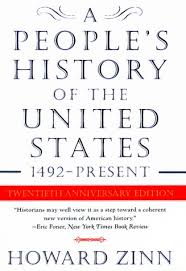 know, such as Columbus, the first Thanksgiving, everything... and got a whole different, new view on it by reading Howard Zinn's A People's History of the United States. This gave us a very interesting side of history, from a more rare point of view-- Native Americans and Africans and African Americans and Women. Through Zinn's book, we the 'traditional' textbook stories, or stories told to us by our elementary school teachers, yet in an unbound, fearless, often heartbreaking manner, because the history of white people against natives and slaves in our country is brutal. (Book image by /libcom.org/files/images/history/zinn.jpg)
Historical Narrative:
Daughter of a Slave Owner Project
Daughter of a Slave Owner Project
northshoresun.timesreview.com/files/T020311_slavery_SCHS_C.jpg
everyone has the same perspective on slaves as she does: She has lived with slaves all her life, they are her family. Lou's mother, on the other hand, has a very different perspective--she treats the slaves as things, not as people. The Civil War also affects Lou and her family when the roots of it begins in 1860-ish.
My Project Reflection
I decided to do my project in the time of slavery because that was the time period that held the most interest and fascination for me. People being owned by other people? The idea now is simply absurd. The fact that it actually happened is ridiculous and repulsive. The fact that slavery still exists today is horrifying. Even in the United States. Can you believe it? I suppose what drew me to this subject, exactly, is the fact that some people back then, who did and didn't have slaves, felt uncomfortable about owning actual people, as they should have been. What interested me the most was how many people must've struggled with slavery and the justification of it, just as Lou, my main character, does in my story. Is it right? Is it wrong? Is it okay if the slaves are treated well? The relationship with planation owners and thier families and the slaves and thier families is quite a web. In many instances, the children were close to slaves because they had been nursed and had grown up with slaves, even as friends. On the other hand, parents might be more distant to the slaves because they didn't have that connection. Relationships in general are complicated and interesting, yet the relationship between a slave and a child whose parents 'own' the slave? That is simply too curious of a relationship to ignore. I really connected to this project because I am so interested in these relationships between people. In different characters, I sometimes put little snippets of people I know or books I read or things that took place in my own life.
I remember reading a story about a girl who killed herself after she was told she couldn't be with her love; I have heard stories as my family and I are gathered around in the living room at my Grandma's house; I've cooked with my Grandma, ran around having nothing but fun with cousins, gardened, listened in on conversations, been to church... all these things and more, have made it into my story because I have experienced it, and so I know how the soft earth smells, and how the light comes in the windows of the church, and the old, beautiful smell that wafts around. I've put a lot of me into my story, and that is the reason most I connect with it.
Something that was difficult for me in this project was knowing what to say next. I put together many little stories to make up a bigger story of Lou's life and the lives of those around her, but after finishing one little tidbit, I'd pause and have to ask myself, 'what story can I make to have some meaning, to give more depth to the characters or landscape or story in general?' I'd usually just start writing, and a story would come out of it, but that is what I struggled with the most-- just knowing where to go next.
I overcame these difficulties by just writing whatever popped into my mind, and I didn't erase much at all of what I wrote in the end... I guess it just sort of worked itself out. I didn't start writing, usually, with an idea of what exaclty, I was going to have Lou learn, or what exactly I was going to show about her or Mammy Turner or Liza or whoever it was.
With my story, I really wanted to have lots and lots of details about life back then--from native plants, to positions of slaves in the house, to weather, to seasons, to traditional farming practices, to the history of Homer, the town that the plantation is based near in the story. I wanted to have it all there. We had studied slavery, but I couldn't get those little details out of that, of course. So I ended up doing a ton of research--I've got atleast thirty sources-- just on little things I'd look up, like the Bonnie Blue flag, or girl's names of the 1800's, or male slave names of the 1800's. And I would add all of it into the story, for a rounder, more brilliant setting and characters. So I learned that to turn history into narritive, you have to know what you're talking about, and to do that, you usually have to do research.
The interesting thing that I found out after the project was over, and I wrote to my Grandma about it, and she told me that her Grandma--my great-great-grandma-- lived in Kentucky and her family had a farm with slaves. My Grandma told me that she was very bitter about it, because they had lost thier plantation during the Civil War. It was so interesting to hear about that. I felt ashamed, too. For some reason, I had always my good family as never owning slaves. Yet I bet that many people today had ancestors that were slave owners. If I had known that, I'm guessing I would have a tough time deciding on which project to do, the novella I ended up writing, or a type of family history about my family and slaver. Hm. Maybe I'll conduct a little research project this summer, or at least ask my Grandma more about it when I see her at Christmas! Ah, I just love history. The type that is about people, though. I don't care about wars, I care about people. They are the interesting ones who often have totally unreasonable reasons for doing things, and who make history. Every person is different, every person has a story to tell... what would our ancestors tell us now? ...And the graveyard would be a hum of voices, all trying to tell thier stories. And you have to press your ear to the ground to hear the words of the person below you. Creepy? Not unless they try to claw thier way out. But they won't do that. They're resting. Their only job now is to tell their story, whether to the night air, or to somebody actually listening. And then they can sleep...
October 5, 2011
Resources for 'An Often Unseen, Untold Side of the American Revolution: The Women.'
Good day!
I couldn't have written my synthesis without the sources, to which I am now giving credit:
A People’s History of the United States, by Howard Zinn, pages 103, 109-111
‘Women in the American Revolution’ a Wikipedia Page: en.wikipedia.org/wiki/women_in_the_American_Revolution
‘Revolutionary Women’a page by Colonial Ancestors: colonialancestors.com/revolutionary/women.htm
‘Woman History’ a page: www2.lhric.org/spbattle/wohist.html
Thanks to all these sources!
~ The Blogger
October 5, 2011
An Often Unseen, Untold Side of the American Revolution: The Women
October 4, 2011
Women's Role in the Revolution
Women, such as “Molly Pitcher,” who allegedly fired her cannon away to help fight the Revolutionary War, are placed into history books to satisfy the demands of modern people who have a need to see equality. Did women actually play a large role in the American Revolution and aren’t recognized for it? Or did they simply play a role too minor to be mentioned in textbooks? I say that women did play an important role in the American Revolution, yet are largely and unfairly unacknowledged for it.
Through my study, I have found that women have played part in bringing about and participating in the Revolution, but not as main figures. It was the men who were the explorers, the politicians, the military figures, the merchants, the landholders. They were the ones with the power. They were also the ones who knew how to write down what they did. In 1750, 90 percent of the white male population could write, yet only 40 of women could. Women were not even mentioned in the Declaration of Independence. But that does not mean that women were absent from the Revolution- by no means. Women were very much involved in helping their country.
For example, when the colonists found out that Britain was taxing them without representation, the women boycotted everything from silks and satins to coffee and tea, opting to knit their own socks and drink water instead. This and buying American goods was a patriotic gesture. It was pointed out in my readings that although men were the ones who created the national policy of “non-consumption boycotts” it was the women who reinforced them within their own homes. There are many stories I found about how women bravely spied on the royal soldiers, carried messages, and pretended they were men in order to fight in battles. One story was about Deborah Samson, who disguised herself as a man during the war and endured hardship and fatigue, but kept up as well as any of the other soldiers. In another story, Anna Warner was dubbed “The Heroine of Groton.” Because she aided the wounded and sacrificed clothing to ‘supply flannel for cartridges.’Many women would follow the American soldiers as they would move from place to place, from battle to battle, producing goods for them, washing and mending their clothes, and cooking for them. Many times, women put up soldiers in their homes, too. In 1777, in a letter from Abigail Adams to her husband, she told about how a large group of women dealt with intolerably high coffee prices: “One eminent, wealthy, stingy merchant… had a hogshead of coffee in his store, which he refused to sell the committee under six shillings per pound. A number of females, some say a hundred… marched down to the warehouse, and demanded the keys, which he refused to deliver. Upon which one of them seized him by his neck and tossed him into the cart…then opened the warehouse, hoisted out the coffee themselves, put it into the trunks and drove off… A large concourse of men stood amazed, silent spectators of the whole transaction.”
So you see the importance of women in the Revolution- but was it enough for them to earn a name in history books? Or what about individual heroines- could their names be beside Paul Revere’s? Through contemplation on this subject, I have concluded that yes, women’s importance in supporting the troops and boycotting should most definitely be included. I also decided that individual women, such as Mary Ludwig Hays, who supplied the soldiers with water and assumed her husband’s duties after he was wounded, or Anna Warner, “The Heroine of Groton,” or Deborah Samson, should be mentioned as well. The reason for this is that these women went beyond what was expected of them. Fighting in the Revolutionary War was expected of a man. You could say that it is just because they are women that that should mean anything more significant, when men were doing the same things. Why aren’t all the men honored, you might ask. But for a woman, it was a big deal, and should be shown to be a big deal in the textbooks. Soldiers are mentioned in textbooks, but women, however, most of the time are not. In several sources, after listing a number of heroines as I just have, wrote out that these examples were just a few of the man women who have served their country with bravery and honor. That shows that this wasn’t just some single act of bravery, but that many women took on these jobs that no one thought they would, which makes it an even bigger deal. A reason women are not heard in the textbooks is because, as I mentioned in the second paragraph, most of them could not write, yet they could not document what efforts they were making. But my opinion is that perhaps textbook authors do not view the efforts women made as anything important- that women were just doing what men were doing, so what? But if you look closely, I think you will find that it is not simply the fact that women are doing what men did- they are going beyond what they were thought of being capable of, and that is what counts.
September 31, 2011
Reflection for Montana 1948
Reflect on the outcome of the seminar. Consider your own performance and the seminar overall. How did you do personally and how did the group do collectively? What grade do you deserve on the seminar?
As a group, I think we did very well in some aspects, yet we could approve in others. Something that I liked that we did is that we went very deep into some subjects, and, especially when we got to the topic of, ‘Was justice served?’ there was a very heated discussion that shows we all had thoroughly read Montana 1948 and that we had thought deeply about it and decided where we stood on the subject. However, sometimes we talked over each other, and other times just a few people dominated the conversation, while several others were very quiet. We did get much better at this toward the end of the seminar, but at the beginning and middle, it was quite chaotic, nobody could be heard, and there was not enough ‘inviting in’ of the quiet peers.
I believe that I deserve somewhere between a B and an A for this seminar. I could have done better in some areas, yet in other parts, I did pretty well. For example, I know I could have talked more. There was one question where there were so many people speaking at once, it was hard to get my voice in. However, I voiced some longer ideas as well, a few which I pointed out some parts in the text to back me up, and was beneficiary for the whole group. Even when I wasn’t talking much, I did ‘invite in’ two people, (I think it was Bryan one time, and I forget who the other time,) so that they could say what was on their minds. I actively listened the whole way through, and added in many “uh-huh’s” and “I agree’s” and nods, which shows I was following along with the conversation every step of the way.
React to your peers’ ideas (be specific) and the meaning you all constructed together. How did your thinking about the text change as a result of this seminar?
Jonathan said that because of the racism that Frank grew up in, maybe he didn’t view the women he was raping as ‘women,’ because back then, many white people thought that Native Americans, (as well as people of any other race,) were not fully human. So if the women were not actual people, why would Frank feel guilty about touching them inappropriately? I thought that was an interesting point, but if someone was acting inappropriately around anything, from an animal to a doll, I would think that that would be wrong. It just rubs me the wrong way to be thinking or acting like that in any situation. So I think that even if Frank did not view the women as human, he still had issues about what is okay and not okay. Even if he didn’t think what he was doing was wrong, that doesn’t make it okay, (as Sara pointed out.)
Then, when we were talking about reasons Frank might’ve committed suicide, there was conversation on whether he did it to protect his family, (which was Hank’s opinion,) or because he felt sorry for himself, (Sara’s thought.) I personally agree with Sara, because he did not strike me as one to sacrifice himself for the love of his family. I think Frank was embarrassed and ashamed of the disgrace he would face if he were in the local jail. (Remember earlier, when he asked to be put in the basement instead of jail.) In my opinion, he was just thinking of himself, and he did not want the town, as well as his family to disgrace him. His suicide, in my opinion, was an act of selfishness and desperateness, not of selfless love.
Another major discussion that really had some heat to it was around the question, ‘Was justice served?’ I thought it was very interesting, (and Sara pointed this out,) that generally the girls in the class thought that justice had not been served to the women that had been harmed by Frank, that it would have been better if Frank would have been punished by the law, and that if he and his crimes could be pointed out so that it would not happen again. (I cannot accurately remember, but I think it was Sara or Cori who said that Frank’s death was his own choice, so it wasn’t justice served.) The boys mostly all said that, on the other hand, justice was served because Frank’s death was enough, and he wouldn’t be around to harm anyone else.
My thinking about the text stayed mostly the same, except for some new insights, such as the possibility that Frank did not view the women as human as himself, as well as my opinion that justice was not served to the women, which was brought to the light more for me. I suppose that it is difficult nowadays to put ourselves in the racist mindset of white men back then because our culture is so against being racist, it doesn’t even occur that a Native American woman back then wouldn’t be considered fully human. Thinking about that possibility gave me a glint of hope for Frank that he wasn’t such a bad person, but then I think back to Wesley coming back up the stairs, alone, and telling his family that Frank was hopelessly guilty, that he couldn’t possibly let him go free. That’s when I realize that Frank must know he is a criminal because he wouldn’t act or be guilty. Yet again, if he didn’t think the women were fully human, he wouldn’t act like he was sorry… But it is still an atrocious act to perform, even if it was not to a person, in my opinion. Just… disgusting. And as for my opinion that justice was not served to the women, it is one thing to write why you think something, and it is another to back yourself up in front of others. When I was writing why I did not think justice was served two nights ago, I knew that that is probably where I stood, but today as I was defending it, I had one opinion, and nothing could change my mind. Particularly when it was brought up that Frank’s suicide was to protect his family, that his family would’ve suffered so much more if Frank’s actions had been brought to light before the whole community. Yeah, right. Frank is not such a compassionate soul, in my opinion. And while David’s family would’ve suffered more with this information out and about, how could it compare to the suffering dozens of girls and their families had to go through? It doesn’t compare. So that is how I found where I truly stood on that issue.
Synthesis- Make an interpretive claim about the text and support it with evidence. Your claim may be something you develop further from your seminar prep, or it may be a new idea that you acquired during the seminar. In some way, it should address the key question of the seminar: What commentary does Montana 1948 make about life in America?
Montana 1948 says that everyone has a story to tell. Everyone’s perspective is different, and there are so many things that make up a person, that make up a life. America is full of people who come here from different places for different reasons. All these people come from a different culture, a different time, a different home. Everyone, like David, has an empty house that we once left and that we’d rather not go back and visit because it would bring back painful memories. Yet we still have these memories, these secrets, tucked inside us, like a treasure box crammed into an attic, or a criminal uncle hidden in the basement. We all have a story to tell, and we are the only ones who can tell it- who can tell our side of the story. It might not be something big, something that is bound to be published and rated at the top of the best-seller’s list, but once it’s out there, it’s... there. It might be a story told, a journal showed, a recipe shared, or pictures passed down. But what magic can become of it! In fact, what magic could become of all of our stories, for all stories are unique and show a unique perspective only we have. Listening to my Dad’s stories of life on the farm, looking at photographs of my grandpa as a boy, eating the rolls and pie my great-grandmother taught my grandmother to cook when she and my grandpa were young newlyweds. Doesn’t learning history, especially your history, spark a flame in your heart, an energy in your soul? Now the only question is, do we want to share our story, our piece of history to be preserved for generations to come, so that they may learn about life in these times? And if so, when?
September 30, 2011
Seminar Prep-- Montana 1948
Discuss how one character could be thought to represent something fundamental about America.
I think Frank could be thought to represent America’s white population and government in general in the late 1700’s, 1800’s and early 1900’s. Why? First let’s look at Frank’s actions. He was sexually abusing many Native American women, and he knew it. Yet he did not stop until someone forced him to, and put up consequences for it. Then, he killed Marie because she knew what he was doing and she could provide a testament for Frank’s actions. He was afraid, and so he did what he thought he had to. And what happened in the end? Yes, Frank killed himself, but there was still not justice served for the women he harmed and Marie, whom he killed. What he did was covered up and was long forgotten for many except the people it affected the most- Marie’s family presumably; Gloria; Frank and Wesley’s parents; Wesley; Gail; and David. How does this relate to America? Because starting when the white man came to America, (and this can be all of the Americas, though I will be focusing on North America,) they have been taking, taking, taking from the Native Americans, until they are up against the wall with a knife to their throats. First, the white men came and scattered the natives from their land, taking some of them as slaves. It could be advocated that the white men thought that the natives were ‘less than human’, but come on. You look like a person, you act like a person, you are a person. It continues: Now, the natives are being forced off their land, via the Trail of Tears, and are put into reservations, a small, patchy bit of land, where the people are set up in shacks, they are not allowed to hunt, and are given rations such as flour. They had to walk there. Hundreds and hundreds of miles. So many people died on the way to these reservations. Don’t forget the battles and massacres that went on between the natives and the white men, such as the Little Bighorn or Wounded Knee. And what were the consequences for killing these people? For harming them, for forcing them, for taking what was theirs, for everything? Nothing. No consequences, except for a few battles won, some land being returned… But that does not make up for the damage done. Now that history is mostly only left in those whom it affected the most: the natives, and a few white men who care enough to know. And even now, it is being forgotten.
What is the significance of the setting of this novel?
The setting is significant because in that time, in 1948, the white men were still in charge. Native Americans were now on their reservations, with white people living near and around them, yet they generally did not mix. I would think that the natives would regard the white people as ignorant and controlling, at least the elders who still remembered the hardships the white men employed on them. But perhaps for the younger generations, they viewed the white men as perhaps something to be wary of, or perhaps the opposite- perhaps there was no need to be suspicious, but to not mix paths too much. Either way, the white men still generally viewed the Native Americans as ‘savages’ just getting accustomed to the ‘white ways’, such as doctors, certain food, and everything about ‘white culture’. Back then, the natives were looked down upon as not as intelligent, savage, and unlearned. Basically, they were just looked down upon. This is significant because it shows how big of a deal it was for Wesley to charge Frank with sexual assault for Native American women- back then, most white men would probably say, “who cares?” Wesley is really standing up for native’s rights and justice. It would have been a big decision for Wesley, because natives are looked down upon, whereas nowadays, it would be obvious to send Frank to jail.
Is justice served at the end of the story?
No, I do not think justice was served at the end of the story. Although Frank’s death is certainly a physical enough punishment for him, it did not do justice for the women he raped and Marie, whom he murdered. He needed to be pointed out, he needed to be tried. That is my opinion. I do not wish for a greater punishment for Frank, but just a different one. It is good that the women do not have to worried about going to the doctor, but… it was not necessary for Frank to die, only that the women and families he hurt be apologized sincerely, and whatever else the law declares.
What does this novel seem to imply about history?
When David grows up, he becomes a history teacher at a high school. What does he say about history? He does not believe for a moment that history is set in stone, that everything that happened the way it says in the history books. And how can it, when there are so many sides to the same story? It would take a 600-page history book just to get down everyone’s own experiences on one single event. Therefore, I would say that the novel implies that history is not all it seems, and before you take everything you read about in a history book, or anywhere, really, to heart, know that there are always many, many sides of the same story. The version you are hearing about or reading has been tailored to fit the view and circumstances of the person who is telling it.
September 18, 2011
Response to the movie CRASH
Is racism natural? I would have to say that now, having seen Crash, that racism is not natural. Noticing other people’s race is not being racist. But seeing the animosity in the exchanges between people, the rudeness, the mean things people say to each other… that’s not natural. Racism in the way that people treat each other with unkindness and unjustness is not natural. People were not meant to act like that with each other.
Claim for Columbus- September 16, 2011
Christopher Columbus is a man who made history because of his explorations and discoveries, yet history has failed to realize what real damage Christopher Columbus did to the future of the place we call the United States, which is now our past and our realization to make.
Bartoleme de Las Casas, in his books, Brief Account of the Devastation of the Indies, wrote,‘…our Spaniards, with their cruel and abominable acts, have devastated the land and exterminated the rational people who fully inhabited it. We can estimate very surely and truthfully that in the forty years that have passed, with the infernal actions of the Christians, there have been unjustly slain more than twelve million men, women, and children.’ The Spaniards wiped out the whole race of people- granted, there are other natives who live in north and south America, but none exactly like these. For all people are different, and this kind can never be again. Who knows who they are? Who knows what they learned or invented? Their secrets died with them. Their culture died with them. We will never truly know who these people were and what they were a part of in life on Earth.
Howard Zinn, in his book, A People’s History of the United States, wrote, ‘Women were important and respected in Iroquois society...Families were grouped in clans, and a dozen or more clans might make up a village. The senior women in the village named the men who represented the clans at village and tribal councils…and removed the men from office if they strayed too far from the wishes of the women. The women tended the crops and took general charge of village affairs while the men were always hunting or fishing. And since they supplied the moccasins and food for warring expeditions, they had some control over military matters. As Gary B. Nash notes in his fascinating study of early America, Red, White, and Black: "Thus power was shared between the sexes and the European idea of male dominancy and female subordination in all things was conspicuously absent in Iroquois society."’ As a female, I can personally say how much of a good thing it would be for men and women to both be equal and respected in a society. As a woman, I can personally say that I empathize with women in the United States and around the world who are not treated with equality and dignity we deserve. I know how it feels. I know what it’s like to have someone say, “You can’t do that, you’re a girl.” In our culture in the United States, people are supposed to be treated equally, but it doesn’t always happen. Women are a minority. Women are still paid less than men, according to Time U.S. How do you think that makes us feel? You can’t really know how it feels until it’s happened to you. But so what, you might say, so what if your big brother teases you and says, “You can’t do that, girls are weak.” But it’s the whole idea of putting someone below you because she’s a woman that is unfair, that is not right. That putdown might not be a big deal, but in other places, like in Ukraine, where girls are sold as prostitutes, it is a big deal. The whole mindset needs to stop. Men may argue that women are always treated the same, and in many cases they are. But if you look in the shadows, where you have to crouch to see it, you can see that women are not always treated the same. What an accomplishment it would be if women were important and respected in our society.
Zinn continued later with a quote from Native American chief Powhatan to John Smith in Virginia, 1607 that I think fully describes the natives: “Why will you take by force what you may have quietly by love? Why will you destroy us who supply you with food? What can you get by war? …Why are you jealous of us? We are unarmed, and willing to give you what you ask, if you come in a friendly manner, and not so simple as not to know that it is much better to eat good meat, sleep comfortably, live quietly with my wives and children, laugh and be merry with the English.”’ It portrays how the natives were: Mostly peaceful, friendly, loving each other, and knowing what the truly matters in life.
Las Casas also wrote, ‘These are also poor people, for they not only possess little but have no desire to possess worldly goods. For this reason they are not arrogant, embittered, or greedy…they are very clean in their persons, with alert, intelligent minds.’ The world we live in is unjust and unfair mostly because of arrogance and greediness- our wants. What we want takes over until we are just thinking about ourselves. What if we had all we needed, all we wanted? How would that make us a better people? It is amazing for us to think about living like that- yet, according to Las Casas, that is how these people were. How amazing is that? Can you think about what life here would have been like if Columbus had not forced his way in when he came to the Caribbean Islands? What would have happened if the Spaniards had lived peacefully with the natives, learning to live as they lived? Just imagine Columbus taking this mindset back to Spain. Because Columbus set the foundation for the English settlers to come to the New World, the mindset would have been with them when they came to the east coast of what is now the Unites States. How amazing would it have been if the immigrants had taken in the customs and ways of the natives… what a different place we would be in today. But what a wonderful thing it would have been- to live close to the earth, where men and women are equal, to have no need for worldly things that don’t really matter, to be harmonious with each other. What a different world we would live in. And yet Columbus didn’t know what a terrible impact he really made on this Earth. Because of him and his men who came to the islands with him, we have nothing of that culture, that people, who were maliciously slaughtered and worked to death and deformed and raped. There could have been so many things. We could have been so many things. But now, we realize that nothing we do can ever change what happened on those islands.
August 30, 2011
Welcome.
Hello, and welcome to my humanities page! Humanities, if you don't know, is sort of like a mix between Social Studies and History and English.
Our solo 11th-grade Humanities teacher this year is the fabulous Jessica McCallum.
Get ready for essays and responses to essays, films, and more!
Thanks for viewing my blog.
With gratitude,
carly
August 28, 2011
NUMERO UNO.
Hello. Buenas tardes. Salutations.
This is my first blog for Humanities, and at the moment, the subject is American History, with my teacher Jessica. A poem is a great way to start:
NUMERO UNO.
Hello. Buenas tardes. Salutations.
This is my first blog for Humanities, and at the moment, the subject is American History, with my teacher Jessica. A poem is a great way to start:
Here/ in the middle/ of imagination
Right in the middle of my mind
I close my eyes/ And my room’s not my room/ And my bed isn’t really my bed
Time stands still and we discover things/That are sometimes strange and new
And the nicest place/ Is in the middle of imagination/ I think
Seseme Street (what I remember from hearing it when I was little)
Women, such as “Molly Pitcher,” who allegedly fired her cannon away to help fight the Revolutionary War, are placed into history books to satisfy the demands of modern people who have a need to see equality. Did women actually play a large role in the American Revolution and aren’t recognized for it? Or did they simply play a role too minor to be mentioned in textbooks? I say that women did play an important role in the American Revolution, yet are largely and unfairly unacknowledged for it.
Through my study, I have found that women have played part in bringing about and participating in the Revolution, but not as main figures. It was the men who were the explorers, the politicians, the military figures, the merchants, the landholders. They were the ones with the power. They were also the ones who knew how to write down what they did. In 1750, 90 percent of the white male population could write, yet only 40 of women could. Women were not even mentioned in the Declaration of Independence. But that does not mean that women were absent from the Revolution- by no means. Women were very much involved in helping their country.
For example, when the colonists found out that Britain was taxing them without representation, the women boycotted everything from silks and satins to coffee and tea, opting to knit their own socks and drink water instead. This and buying American goods was a patriotic gesture. It was pointed out in my readings that although men were the ones who created the national policy of “non-consumption boycotts” it was the women who reinforced them within their own homes. There are many stories I found about how women bravely spied on the royal soldiers, carried messages, and pretended they were men in order to fight in battles. One story was about Deborah Samson, who disguised herself as a man during the war and endured hardship and fatigue, but kept up as well as any of the other soldiers. In another story, Anna Warner was dubbed “The Heroine of Groton.” Because she aided the wounded and sacrificed clothing to ‘supply flannel for cartridges.’Many women would follow the American soldiers as they would move from place to place, from battle to battle, producing goods for them, washing and mending their clothes, and cooking for them. Many times, women put up soldiers in their homes, too. In 1777, in a letter from Abigail Adams to her husband, she told about how a large group of women dealt with intolerably high coffee prices: “One eminent, wealthy, stingy merchant… had a hogshead of coffee in his store, which he refused to sell the committee under six shillings per pound. A number of females, some say a hundred… marched down to the warehouse, and demanded the keys, which he refused to deliver. Upon which one of them seized him by his neck and tossed him into the cart…then opened the warehouse, hoisted out the coffee themselves, put it into the trunks and drove off… A large concourse of men stood amazed, silent spectators of the whole transaction.”
So you see the importance of women in the Revolution- but was it enough for them to earn a name in history books? Or what about individual heroines- could their names be beside Paul Revere’s? Through contemplation on this subject, I have concluded that yes, women’s importance in supporting the troops and boycotting should most definitely be included. I also decided that individual women, such as Mary Ludwig Hays, who supplied the soldiers with water and assumed her husband’s duties after he was wounded, or Anna Warner, “The Heroine of Groton,” or Deborah Samson, should be mentioned as well. The reason for this is that these women went beyond what was expected of them. Fighting in the Revolutionary War was expected of a man. You could say that it is just because they are women that that should mean anything more significant, when men were doing the same things. Why aren’t all the men honored, you might ask. But for a woman, it was a big deal, and should be shown to be a big deal in the textbooks. Soldiers are mentioned in textbooks, but women, however, most of the time are not. In several sources, after listing a number of heroines as I just have, wrote out that these examples were just a few of the man women who have served their country with bravery and honor. That shows that this wasn’t just some single act of bravery, but that many women took on these jobs that no one thought they would, which makes it an even bigger deal. A reason women are not heard in the textbooks is because, as I mentioned in the second paragraph, most of them could not write, yet they could not document what efforts they were making. But my opinion is that perhaps textbook authors do not view the efforts women made as anything important- that women were just doing what men were doing, so what? But if you look closely, I think you will find that it is not simply the fact that women are doing what men did- they are going beyond what they were thought of being capable of, and that is what counts.
Through my study, I have found that women have played part in bringing about and participating in the Revolution, but not as main figures. It was the men who were the explorers, the politicians, the military figures, the merchants, the landholders. They were the ones with the power. They were also the ones who knew how to write down what they did. In 1750, 90 percent of the white male population could write, yet only 40 of women could. Women were not even mentioned in the Declaration of Independence. But that does not mean that women were absent from the Revolution- by no means. Women were very much involved in helping their country.
For example, when the colonists found out that Britain was taxing them without representation, the women boycotted everything from silks and satins to coffee and tea, opting to knit their own socks and drink water instead. This and buying American goods was a patriotic gesture. It was pointed out in my readings that although men were the ones who created the national policy of “non-consumption boycotts” it was the women who reinforced them within their own homes. There are many stories I found about how women bravely spied on the royal soldiers, carried messages, and pretended they were men in order to fight in battles. One story was about Deborah Samson, who disguised herself as a man during the war and endured hardship and fatigue, but kept up as well as any of the other soldiers. In another story, Anna Warner was dubbed “The Heroine of Groton.” Because she aided the wounded and sacrificed clothing to ‘supply flannel for cartridges.’Many women would follow the American soldiers as they would move from place to place, from battle to battle, producing goods for them, washing and mending their clothes, and cooking for them. Many times, women put up soldiers in their homes, too. In 1777, in a letter from Abigail Adams to her husband, she told about how a large group of women dealt with intolerably high coffee prices: “One eminent, wealthy, stingy merchant… had a hogshead of coffee in his store, which he refused to sell the committee under six shillings per pound. A number of females, some say a hundred… marched down to the warehouse, and demanded the keys, which he refused to deliver. Upon which one of them seized him by his neck and tossed him into the cart…then opened the warehouse, hoisted out the coffee themselves, put it into the trunks and drove off… A large concourse of men stood amazed, silent spectators of the whole transaction.”
So you see the importance of women in the Revolution- but was it enough for them to earn a name in history books? Or what about individual heroines- could their names be beside Paul Revere’s? Through contemplation on this subject, I have concluded that yes, women’s importance in supporting the troops and boycotting should most definitely be included. I also decided that individual women, such as Mary Ludwig Hays, who supplied the soldiers with water and assumed her husband’s duties after he was wounded, or Anna Warner, “The Heroine of Groton,” or Deborah Samson, should be mentioned as well. The reason for this is that these women went beyond what was expected of them. Fighting in the Revolutionary War was expected of a man. You could say that it is just because they are women that that should mean anything more significant, when men were doing the same things. Why aren’t all the men honored, you might ask. But for a woman, it was a big deal, and should be shown to be a big deal in the textbooks. Soldiers are mentioned in textbooks, but women, however, most of the time are not. In several sources, after listing a number of heroines as I just have, wrote out that these examples were just a few of the man women who have served their country with bravery and honor. That shows that this wasn’t just some single act of bravery, but that many women took on these jobs that no one thought they would, which makes it an even bigger deal. A reason women are not heard in the textbooks is because, as I mentioned in the second paragraph, most of them could not write, yet they could not document what efforts they were making. But my opinion is that perhaps textbook authors do not view the efforts women made as anything important- that women were just doing what men were doing, so what? But if you look closely, I think you will find that it is not simply the fact that women are doing what men did- they are going beyond what they were thought of being capable of, and that is what counts.


